Up to 70 Percent Given Away, for Lack of Knowledge?
November 26, 2026
AI SEARCH AND B2B PURCHASING
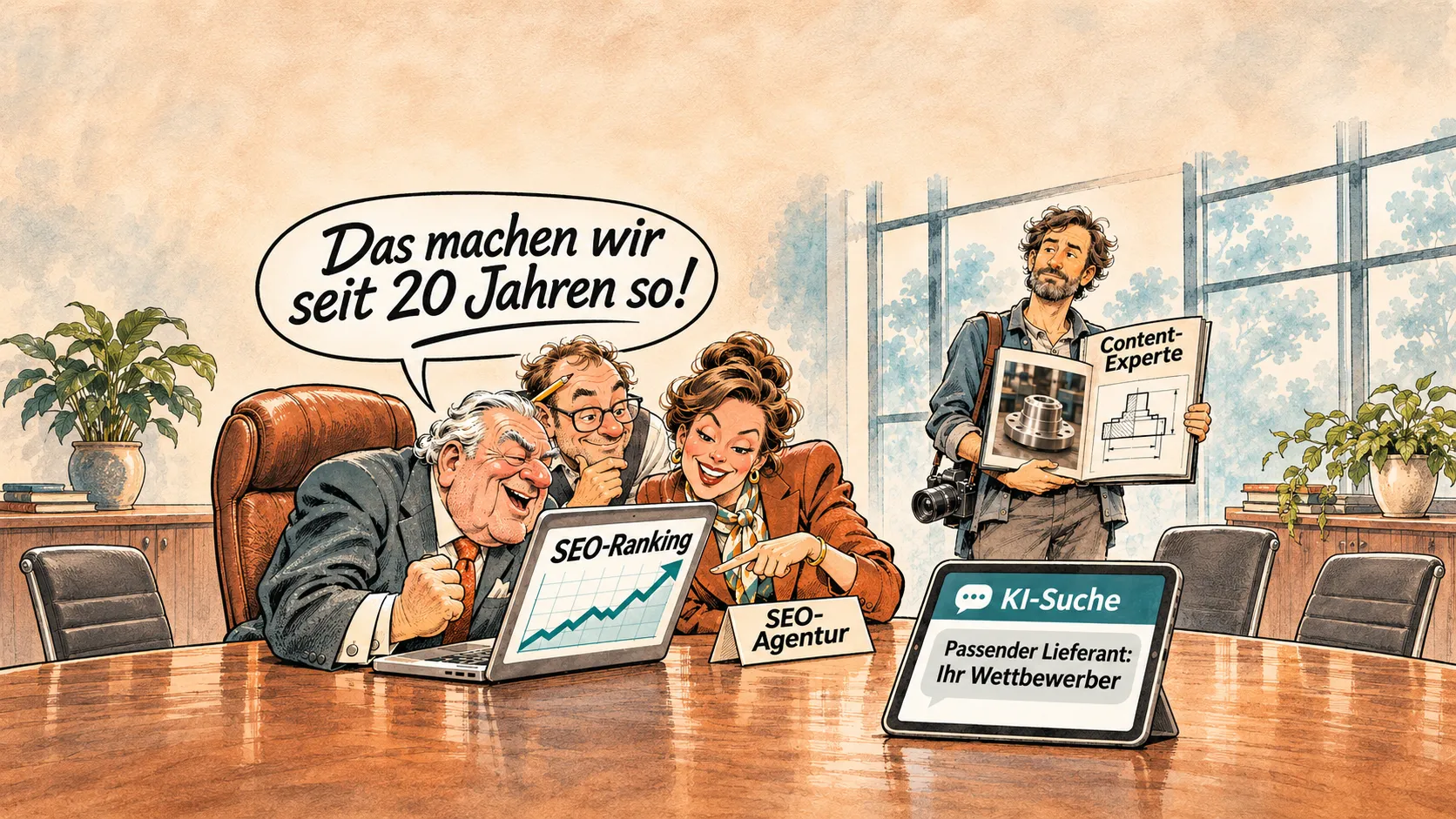
When the inquiry lands with your competitor, you never hear about it. The sentence “That’s what we pay our SEO agency for” can sweep off the boardroom table exactly the offer that is still missing.
By Matthias Nieschke, FineARTStyle
In brief
- An AI search can recommend a supplier without you ever learning of the inquiry.
- According to Google, paid ads have no influence on organic AI answers.
- In Matthias Nieschke’s analysis checks, most company presences reach 30 to 45 percent of their potential impact.
- Check your agency contract to see who produces the evidence from inside your business.
Buying ads and optimizing your website for search engines makes sense. Yet nobody has thereby been commissioned to answer the questions by which a buyer chooses suppliers.
New technology often has a hard time at first. Around 1900 people had to be told that a motor car was not the devil’s work. In the mid-1990s some took the internet for a better fax machine. Today, search powered by artificial intelligence answers questions for which, only a few years ago, you had to click through long lists of results. Whoever offers a solution for this new situation often has to wait until the other side has understood the problem. The new technology can be very good for sales, provided you know what it builds its answers from.
The AI inquiry that appears in no report
Take a machine builder looking for a second supplier for a small series. He asks an AI search for companies that machine stainless steel to drawing, supply a measurement report and can remanufacture individual parts on demand.
Your company has been able to do this for years. Your website says “precision and flexibility.” Your competitor shows a comparable workpiece, states the batch size and explains which inspection the customer receives with delivery. In our case, the AI answer points to their project report, and the buyer sends them the drawing.
Your sales team never hears of this prospect, because they never visited your website. Next month’s report shows the clicks of your campaign. The inquiry in your competitor’s inbox is missing from every analysis in your company.
How much impact lies idle in your presence?
At FineARTStyle I use a test method developed specifically for this purpose to examine company presences from the point of view of the AI-searching people who decide on an order. They often specify exactly what they are looking for. And that is where the decisive difference lies. A company that demonstrates these requirements on its website can appear in the AI answer.
In my analysis, most presences reach 30 to 45 percent of their potential impact. That leaves 55 to 70 percent unused.[1] These figures come from my own analysis checks, not from a representative study, and they do not tell you how many inquiries an individual company misses.
For management, a different question is more tangible. At which point does a prospect fail, although your company could fulfil the order?
SEO, GEO, ads: what have you ordered, what is missing?
- Ads. With Google Ads the agency runs ads, manages budgets and measures results. That is a sensible assignment. According to Google, however, paid advertising has no influence on organic AI answers.[2]
- SEO (search engine optimization). It provides accessible pages, understandable service descriptions and a structure in which people and search systems find what they need.
- GEO (optimization for AI answers). It asks for which customer questions your company shows up in a generated answer, how your service is described there and which source the statement rests on. The two disciplines overlap. Google itself still counts optimization for its AI search as SEO.[3]
- Content. Someone has to talk to the person responsible for inspection, pick the right workpiece, photograph the production step and obtain approval for the reference.
Who gets the answer out of the company?
Only after this work can your website state what requirement a customer had, what your team delivered and under which conditions you can deliver it again. A buyer can assess this context, and an AI search can find it as a source. Google explicitly recommends content with a first-hand perspective, supported by good images and video.[3]
A photo of a measuring machine shows a measuring machine. A picture of the actual workpiece in its fixture, together with the inspector’s explanation, already answers a purchasing question. An approved project report records which process was used, how far the inspection went and how to reorder.
Company history works in a similar way. During a generational change, a long-standing customer wants to know who will understand their drawings, decide on complaints and be able to commit to dates. An anniversary year hardly helps them with that.
Selection starts before the first visit
According to Bitkom, as early as 2025 half of internet users in Germany used an AI chat instead of classic search at least occasionally.[4] In a survey published in November 2026, 51 percent of online shoppers said they had already used AI to search for products.[5] Both surveys asked people aged 16 and over. They do not give a share for industrial purchasing.
How early contact with a customer can be lost is shown by an analysis from the Pew Research Center, covering Google searches by 900 US adults in March 2025. When the results page contained an AI summary, a click on a classic result followed in 8 percent of visits. Without a summary it was 15 percent.[6] If you explain your expertise only after the click, you have to hope that the click happens.
When you really pay twice
Put your existing agency contract next to the new offer and ask three questions.
- Who identifies the customer questions that decide the order?
- Who researches the answers inside your company?
- Who delivers the technically approved reference report, the photo series or the film about the inspection process?
If your agency has promised exactly these results, the offers overlap. If the contract covers ad management, search optimization and reporting, producing the evidence is a separate assignment.
Where FineARTStyle’s work begins
With an analysis method of my own, I examine 50 to 100 points, depending on the industry. On site, I compare your public presence with what management and specialists can substantiate. You receive written findings with priorities. From these I develop the concept and produce the agreed content. Your agency can continue to run ads and optimize pages. It gets material that can only come from your company.
Take the last demanding inquiry your sales team won and remove your company name from the brief. Would a buyer searching today via AI for exactly this service find a solid reason to send the next drawing to you of all companies?
Questions management teams ask
Is an SEO agency enough for AI search?
SEO remains the foundation, and Google counts its AI search as part of it. The agency needs content from inside your company. Whether it produces that itself is written in the contract.
Do Google Ads influence AI search answers?
According to Google, paid ads have no influence on organic AI answers.
What is GEO?
GEO stands for “generative engine optimization,” optimization for AI answers. It looks at the customer questions for which a company is named, how it is described and which source lies behind the statement.
Which content helps buyers and AI search?
Concrete first-hand evidence, such as a picture of the machined workpiece, the inspector’s explanation or an approved project report.
Who is Matthias Nieschke?
Matthias Nieschke is an expert in corporate presence, a photographer and cinematographer with more than 20 years of experience. With FineARTStyle.de in Warngau he works as an adviser and consultant for the German Mittelstand in Munich and throughout Bavaria. His consulting covers marketing, visualization and AI search optimization. He handles production himself, including corporate photography, photos, video production and finished content for websites and sales.
fineartstyle.de/en · Matthias Nieschke on LinkedIn
Sources and context
[1] FineARTStyle, Matthias Nieschke: own evaluation of analysis checks. No representative sample, no figure for lost inquiries.
[2] Google Ads Help: About ads and AI Overviews, accessed November 26, 2026.
[3] Google Search Central: Optimizing your website for generative AI features.
[4] Bitkom: Internet search in transition (German), November 20, 2025. Telephone survey of 1,156 people aged 16+, including 1,030 internet users.
[5] Bitkom Research: How digitally does Germany shop in 2026? (German), slide 9, published November 23, 2026. Base: 1,047 online shoppers surveyed in calendar weeks 37 and 38.
[6] Pew Research Center, Athena Chapekis and Anna Lieb: Google users are less likely to click on links when an AI summary appears, July 22, 2025.